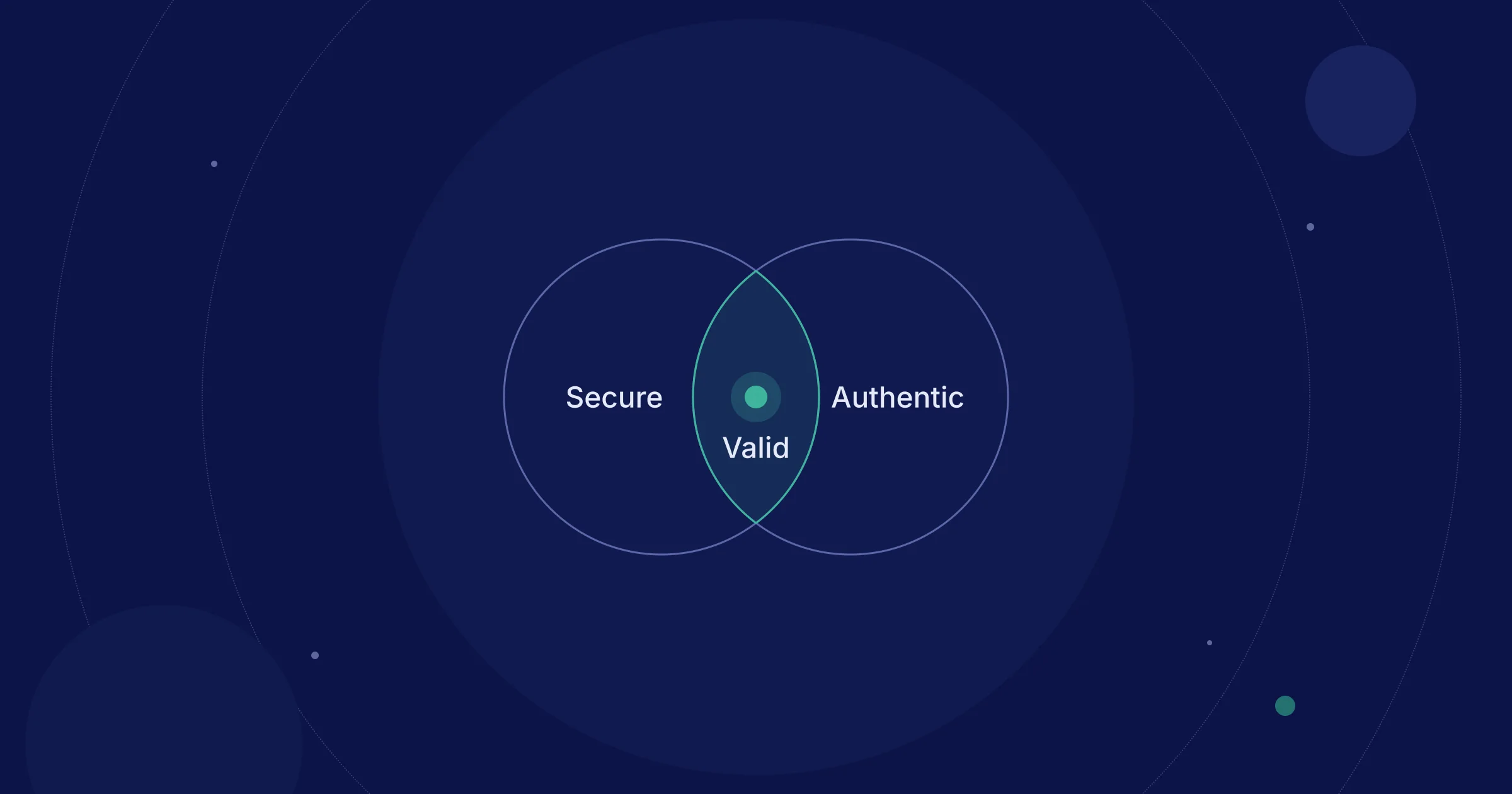
AI has pushed many institutions back to closed-book exams. Those exams are secure, but often too artificial to show what students can actually do. You don't always have to choose: if students do authentic tasks in the software of their discipline within a secure environment, the assessment can be both secure and valid.
Recently, I spoke with a dean at a large UK university about how their faculty of science assesses students. During COVID, they were forced to move many of their exams online. Those exams didn’t survive the arrival of generative AI.
“There’s been a total retreat from those digital exams, having entirely lost all credibility,” the dean told me. “Our response has been to go back to paper-based exams.”
I hear the same at many other institutions. And while a paper exam in an invigilated hall is a reliable way to ban AI usage, the dean was also clear about the trade-off:
“If you restrict yourself to paper-based exams, the kind of questions you ask have to be answerable in that format. And this is just not at all how, for example, electromagnetism is actually approached if you’re using it in a practical sense.”
His faculty can run a secure assessment environment, the dean concluded, “but it will be at the cost of it being rather artificial, because paper-based exams are always rather artificial.”
Secure, but artificial. That’s the trade-off many institutions are making right now. Yes, a closed book assessment can be secure. But what about the assessment's validity?
What is assessment validity?
An assessment is valid when its result lets you draw the right conclusion about what a student can do. A grade is a claim: this student has met these learning outcomes. Validity is how far you can trust that claim.
In their article Validity matters more than cheating, assessment researchers Phillip Dawson, Margaret Bearman, Mollie Dollinger and David Boud argue that validity, not cheating, should be the central concern. Cheating is a problem because it undermines validity: if a student didn’t do the work, the grade says nothing about what they can do.
An assessment can lose its validity in two ways:
- The evidence isn’t the student’s own. Someone or something else did the work: a friend, a contract cheating service or an AI tool.
- The task doesn’t reflect the capability. The student did the work, but the task measures something other than what you want to know, such as reproducing a textbook calculation instead of solving a real problem.
AI has made cheating prevention challenging, causing many institutions to prioritize security by opting for more closed-book exams, often even on paper. This all goes at the expense of whether you're measuring what you're trying to measure.
The balancing act between security and authenticity
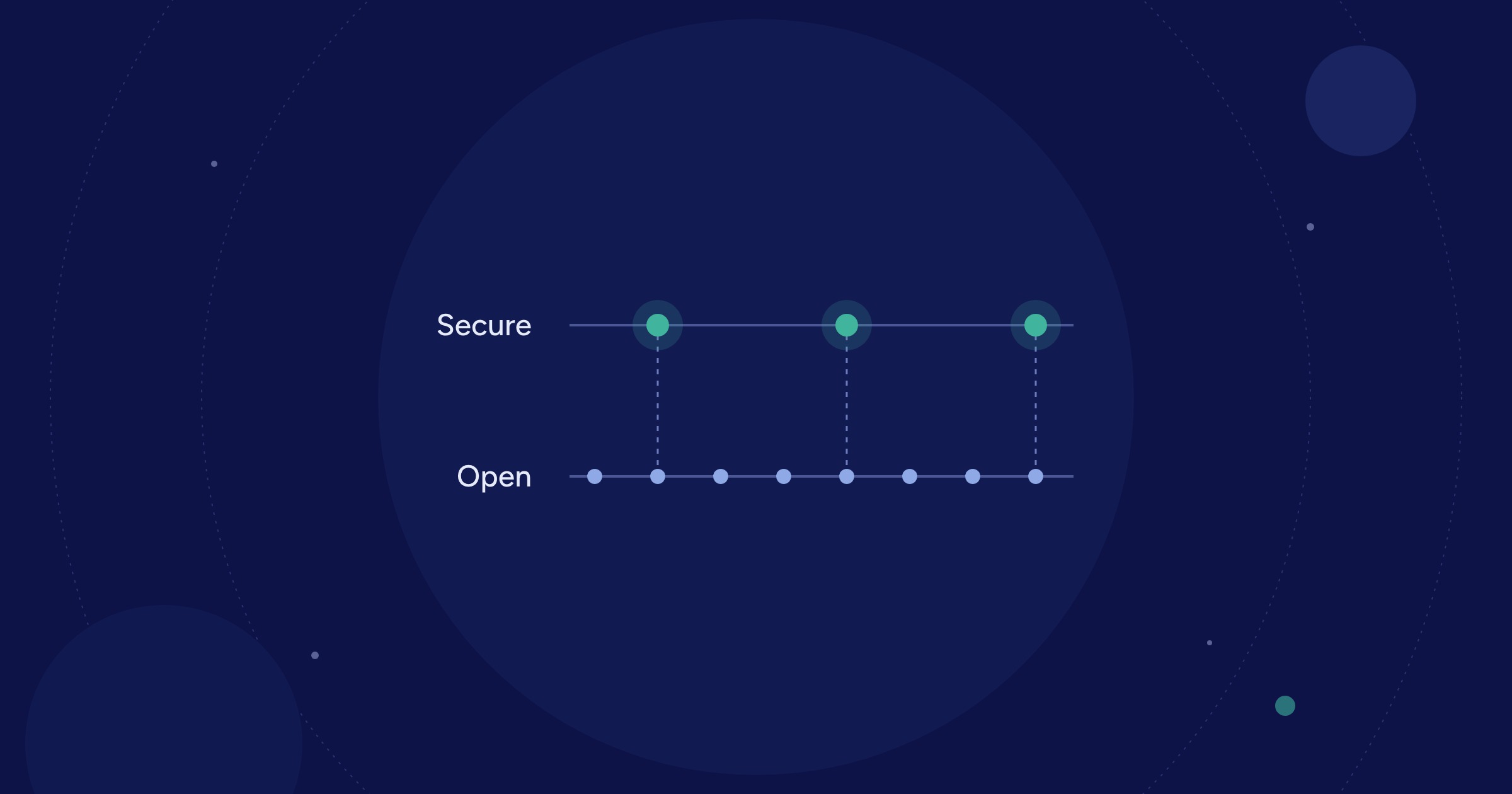
With every assessment, you have to ask: can you be sure the student did the work themselves? And does the task look like the work they’ll do in real life? Here's how the most common assessment formats score on both questions:
- Take-home assignments and projects can be highly authentic: students work on real problems, with tools that are also used by professionals. But with AI and contract cheating services, they no longer prove who did the work.
- Closed book exams measure thinking, not doing. Students can show they know a method, but not that they can apply it the way they would in practice.
- Oral exams are secure and good at assessing how students think. But they’re hard to scale: a 15-minute oral defense for a cohort of 400 students takes 100 hours of examiner time.
Most traditional assessment designs involve trade-offs, and more security doesn’t automatically mean more validity.
Why rules and accountability measures don’t make take-home assignments valid again
One tempting middle ground is to keep take-home tasks and add rules: an AI-use declaration or even a scale of permitted AI use. But rules only work if students follow them, and nothing stops a student from ignoring the rules and opening ChatGPT anyway.
Another solution is to add accountability measures: a portfolio, a reflection report, an export of the AI prompt used for a task, or a short oral about the take-home work. These measures can be helpful, but they don't necessarily make an assessment valid. You’re now mainly testing how well a student can explain and reflect on the work, not whether they did it themselves.
That’s why many institutions are completely rethinking their assessment strategy and running authentic assessments in a secure environment.
The solution: authentic assessments in a secure environment
You don’t have to choose between an authentic task and a secure one.
More and more institutions take authentic tasks that students would normally do at home, like solving a problem in Python, and run it in a secure environment. You measure what you want to measure, and you know for sure the student did the work themselves.
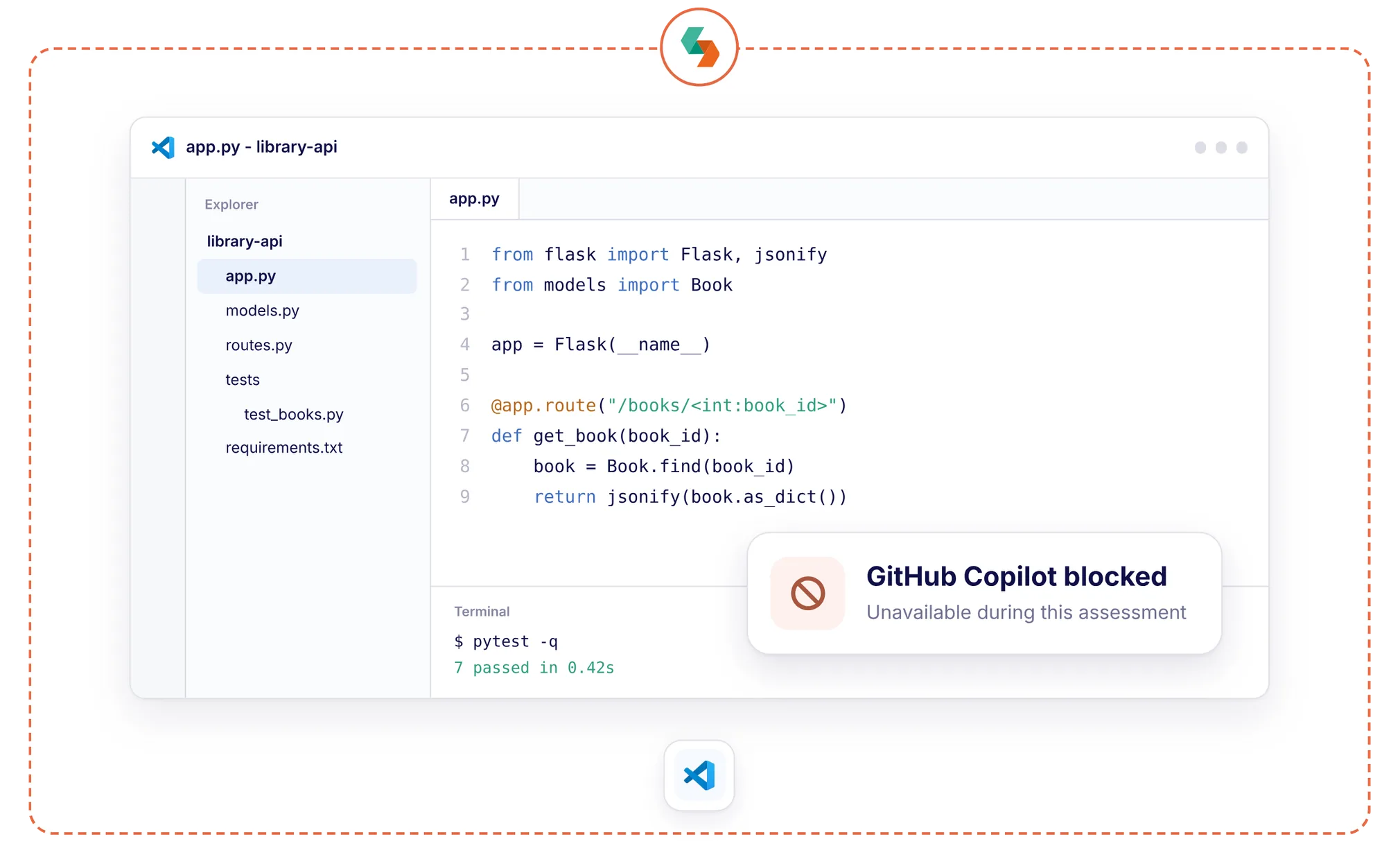
In practice, this is what a secure, authentic assessment looks like:
- True to the real work. The task asks students to do what the learning outcome is about. In physics, that could mean solving an electromagnetism problem numerically in Python, rather than calculating the field of a spherical capacitor by hand.
- The student’s own work. Students take it in person, with the supervision needed to rule out support that isn’t allowed.
- In the right software. Students work in the applications of their discipline, such as Excel, VS Code with Python or RStudio.
- Matched to the learning outcome. You decide which files, websites and AI features students can reach, including inside the applications themselves. If the learning outcome includes working with AI, AI can be part of it.
- Workable at scale. You can assess a whole cohort at the same time, with appropriate supervision.
At Eindhoven University of Technology, the Department of Industrial Engineering and Innovation Sciences runs its final exams in the apps of the field, such as Python and RStudio, on students’ own laptops. In some courses, students who scored well on midterms that weren’t yet AI-proof had a lower passing rate on the authentic and secure final.
How Schoolyear helps you run authentic assessments in a secure environment
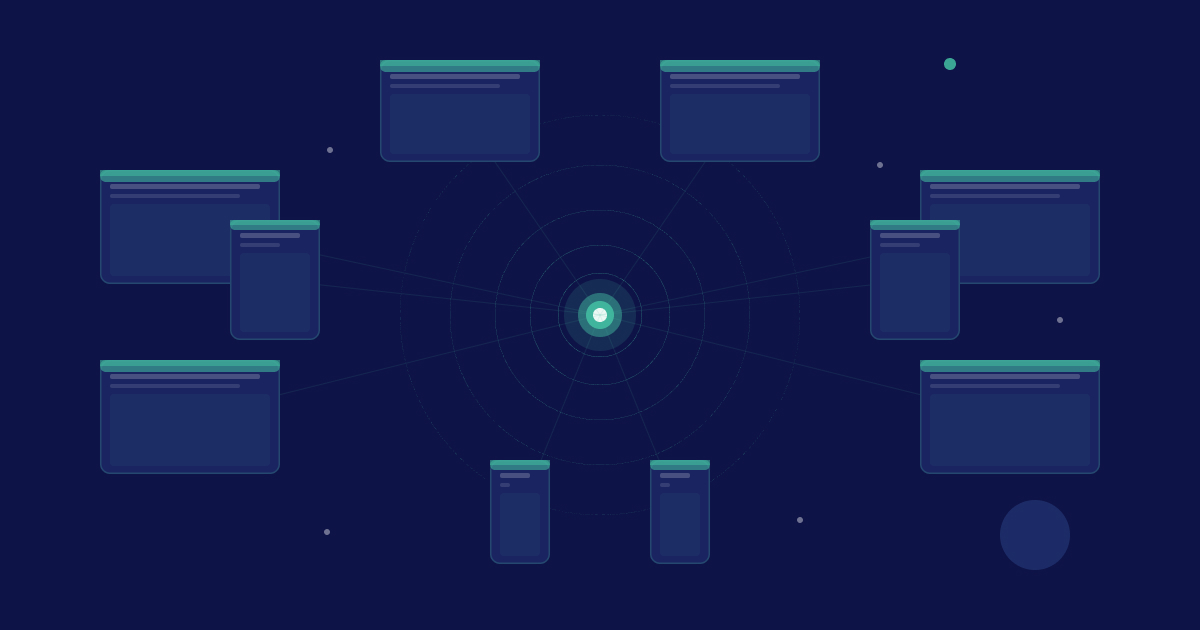
A secure, authentic assessment means students work in an environment closest to the real workplace. They use the applications of their discipline, while you decide what they can reach, including the AI assistants now built into those apps. Schoolyear’s secure assessment workspace makes this possible.
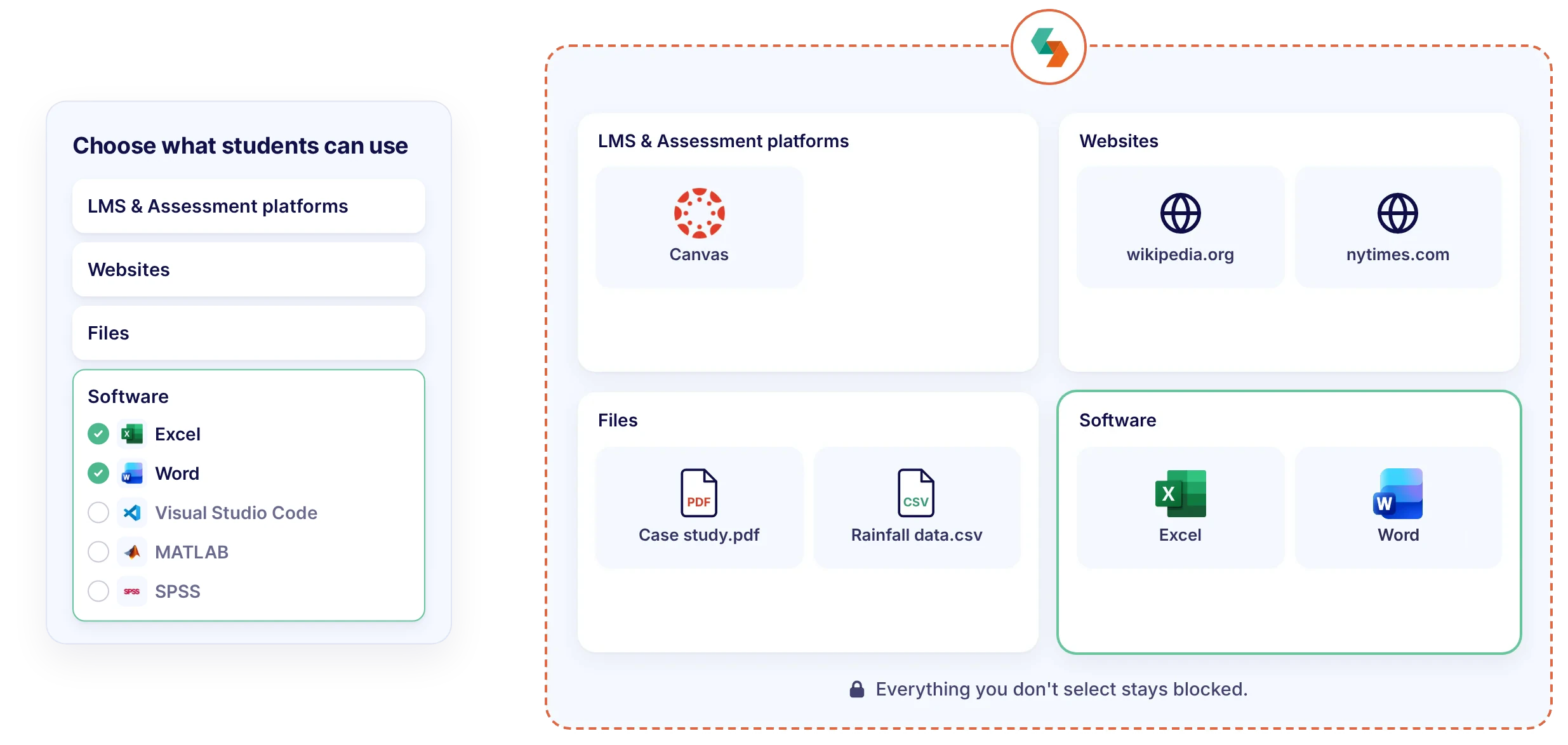
For each assessment, educators decide what students can use:
- Applications, like Excel, Word, VS Code or RStudio
- Files, like a dataset, a case description or a formula sheet
- Websites, like a journal database or online documentation
- AI tools, if they choose to allow one
And they control what happens inside the apps. In Excel, for example, you can turn off Copilot and make only the Solver add-in available.
Secure but artificial, or authentic but open to AI: that trade-off is no longer necessary.
See how secure and authentic assessments with desktop applications work in Schoolyear →
Share this